

There are 69 days left in 2026. Call it ten weeks.
That isn’t a lot, but it’s enough to act on — which is the difference between late October and mid-December, when the same list becomes a list of things you’ll do next year. So this is an inventory, not homework. Four windows close on December 31. Most people have two or three of them. The point today is to know which ones are yours.
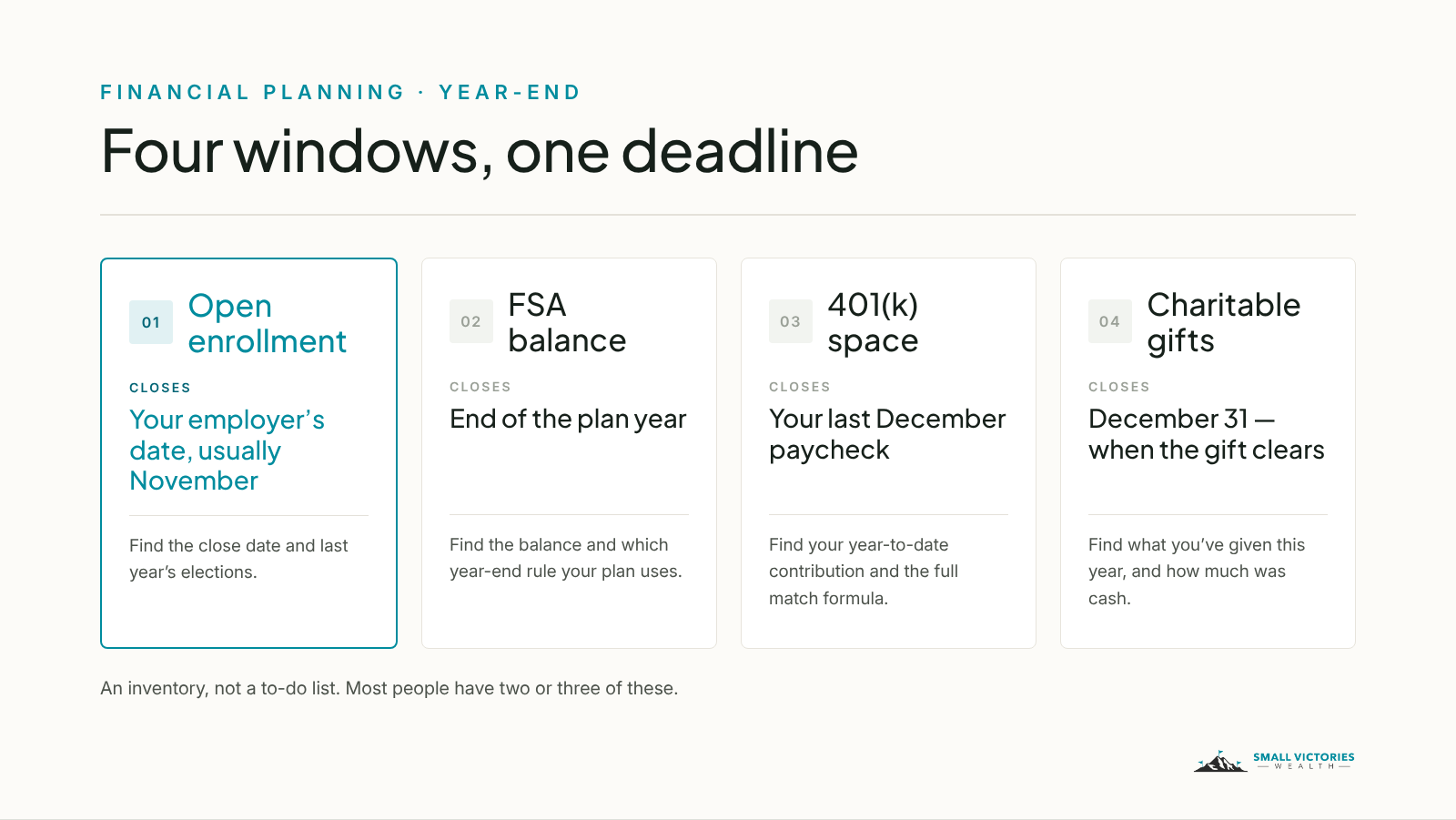
1. Open enrollment
If your employer runs its benefits year on the calendar, your enrollment window is open now or opens within the next couple of weeks, and it closes well before December 31 — usually a two-week window somewhere in November. The deadline that matters is your company’s, not the year’s.
What to find: the exact close date, and what you elected last year. That’s it. If you skipped the earlier posts, the open enrollment post covers how to size your elections from a year of real spending, and the HSA or FSA post covers which account you actually have.
2. Flexible spending account balances
If you have a health FSA, whatever you don’t spend by the end of the plan year is gone, give or take a small carryover or a short grace period depending on your employer’s plan — the plan can offer one or the other, not both (IRS Publication 15-B). A dependent care FSA has no carryover at all.
What to find: your current balance and which year-end rule your plan uses. If the balance is bigger than the dental and vision appointments you’d realistically book before New Year’s, that’s worth knowing in October rather than on December 28.
3. 401(k) contribution space
The 2026 limit is $24,500 (IRS, 401(k) limit increases to $24,500 for 2026), and the only way to use it is through payroll — which means the space you don’t use by your last December paycheck doesn’t carry into January. There are roughly five or six paychecks left, depending on whether you’re paid biweekly or semi-monthly.
What to find: your year-to-date contribution on your most recent pay stub, and your employer’s full match formula. You don’t need to decide anything today. You need the two numbers, because a rate change submitted in November takes effect in time, and one submitted in late December mostly doesn’t.
One more thing here: the IRS normally announces the following year’s limit in early November. When the 2027 number lands, that’s a natural moment to set January’s rate instead of carrying over whatever it’s been.
4. Charitable gifts you want in this tax year
A gift counts in the year it’s made, so anything you want on your 2026 return has to clear by December 31 — and a check mailed on the 30th or a stock transfer initiated on the 29th can easily land in January.
Starting with the 2026 tax year there’s also a new rule worth knowing exists: taxpayers who don’t itemize can deduct cash gifts to qualifying charities, up to $1,000 for single filers and $2,000 for married couples filing jointly (IRS, One, Big, Beautiful Bill provisions). Cash only — stock and goods don’t count — and gifts to a donor-advised fund don’t qualify. If you’ve never bothered tracking donations because you take the standard deduction, this is the first year that changes.
What to find: what you’ve already given this year, and whether any of it was in cash. Keep the receipts.
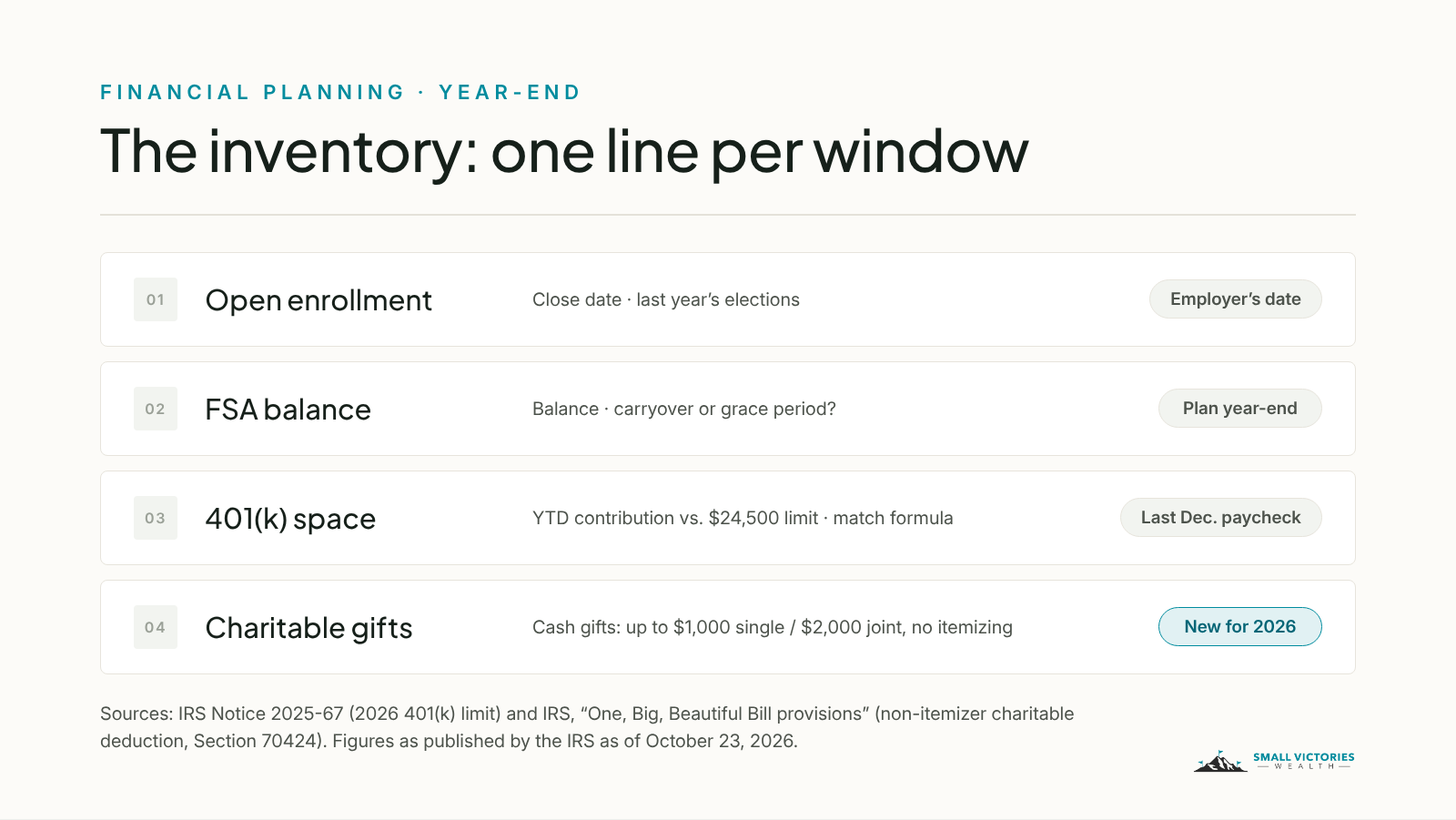
Sources: IRS Notice 2025-67 announcement (2026 401(k) limit) and IRS, One, Big, Beautiful Bill provisions (non-itemizer charitable deduction)
What’s not on this list
Plenty of year-end items have a later deadline. IRA contributions for 2026 can be made until the April filing deadline. Fourth-quarter estimated taxes are due in January. Those get their own post in November, because mixing them in here is how a ten-week list turns into a twenty-item list nobody finishes.
The Small Victory
Write down which of the four apply to you and the one date attached to each. Four lines, ten minutes. You’re not deciding anything yet — you’re making sure that when December arrives, the decisions are still available.
Before you act on this: This post is educational only and isn’t a recommendation for your situation. Enrollment windows, FSA carryover and grace-period rules vary by employer, so check your plan documents. Figures shown are for the 2026 tax year as published by the IRS as of October 23, 2026; the 2027 401(k) limit had not been announced when this was written. Tax treatment of charitable gifts depends on your filing situation — confirm with your tax preparer before counting on a deduction.
